I design self-paced tutorials, software how-to videos, workshops, and learner guides that make complex tools and research skills easy to learn. For more than 13 years at Nova Southeastern University, I have taught students, faculty, and community learners in person, online, and in hybrid formats. I am completing an M.S. in Data Analytics and Artificial Intelligence (December 2026).
A full self-paced course built in Canvas LMS for faculty professional development.
Canvas courseIn development, launching January 2027
Learning SciVal: Faculty Development in Canvas
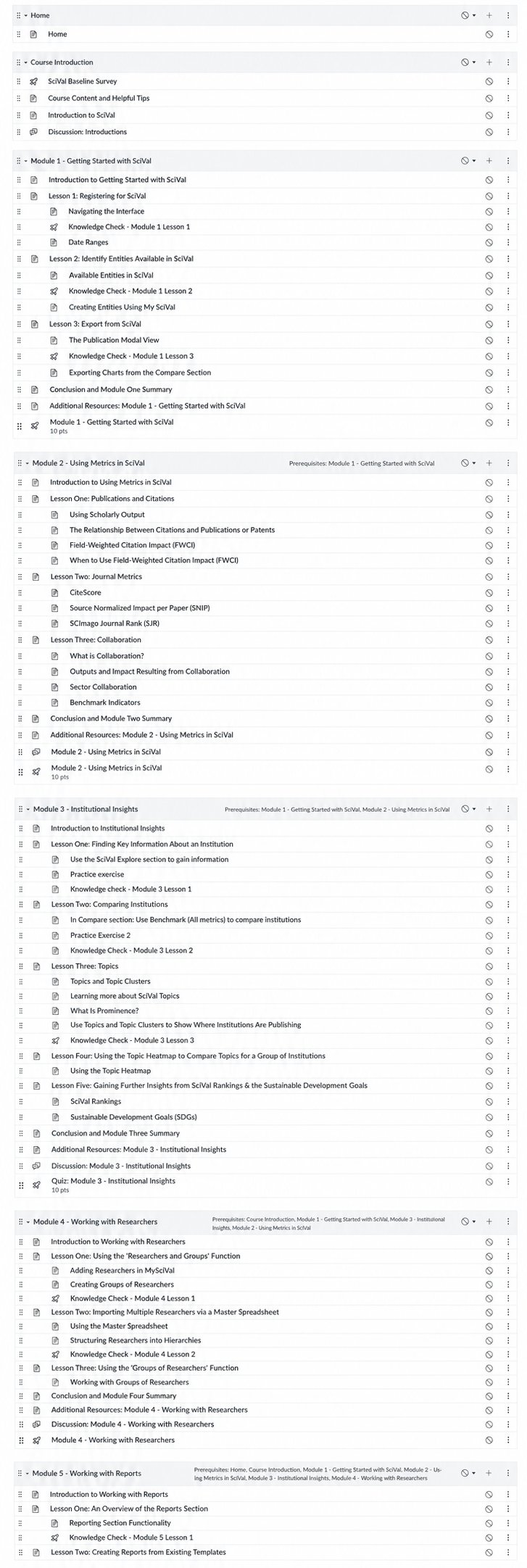
Learning SciVal is a self-paced Canvas course designed to help Nova Southeastern University faculty explore research activity, interpret scholarly metrics, and communicate research impact. Its six-module framework covers platform navigation, research metrics, institutional analysis, researcher profiles and groups, reporting, and responsible use of SciVal.
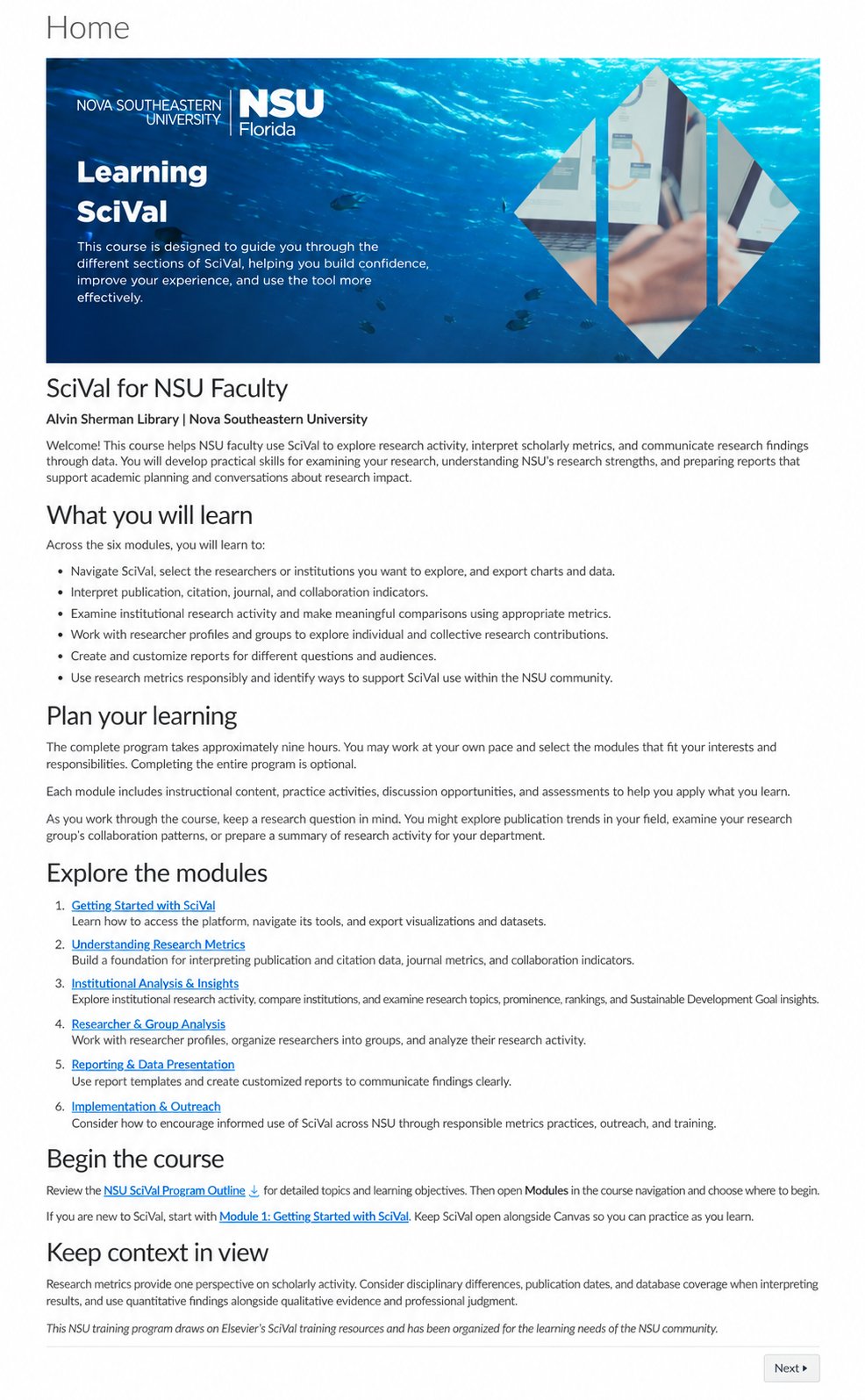
My work focuses on adapting Elsevier’s SciVal training resources for NSU faculty through a revised course outline, customized homepage, university branding, and practical learning goals. The course pairs instructional content with practice activities, discussions, knowledge checks, and quizzes to support application.
The design emphasizes clear navigation, flexible participation, and connections to faculty research needs, including examining collaboration patterns and preparing research summaries. It also encourages learners to interpret metrics in context and alongside professional judgment.
Custom course homepage. Tap to view full size.Module structure with prerequisites and knowledge checks. Tap to view full size.
Self-paced modules I designed and built in HTML, CSS, and JavaScript.
Self-paced tutorialCOMP 1500 course
Evaluate Sources with CARDIO
A self-paced tutorial that teaches computing students to judge whether a source is credible, using the six CARDIO criteria: Currency, Authority, Relevance, Documentation, Information Type, and Objectivity. Learners work through one criterion at a time using a real practice article, answer guided reflection prompts, and complete a knowledge check before they can move on.
The module opens with visual primers on the information cycle and peer review, embeds a video on lateral reading, and ends by sending learners to the required course quiz, so the practice and the graded assessment stay aligned.
A six-step guided tool that turns a vague research idea into a working database search. Learners define their topic (What), angle (Why), and population (Who), see those pieces combine into a research question, add synonyms, and receive ready-to-paste search strings formatted for both multi-box databases and single-box search engines.
It breaks a technical skill that often overwhelms beginners into small, confident steps and gives learners something they can use immediately.
Short, task-focused screencasts for students and the public. I script, record, edit, and caption them.
Screencast2026 update
How to Use Advanced Search in the Catalog
Shows learners how to use filters in the library catalog to find books, ebooks, video games, and DVDs more efficiently. Published with a script and closed captions.
Demonstrates how to search library databases for scholarly articles using keywords, then apply filters to refine results. Published with a script and closed captions.
Live and recorded sessions and programs on AI, data, research tools, and language learning, for students, faculty, and community learners.
WorkshopFall 2026
The Good, the Bad, and the Ugly of AI
A practical, student-focused workshop on how AI can support studying and research, where it goes wrong, and how to use it responsibly. I designed the full package: facilitator script, slide deck, and a leadership-facing overview. The recording is published with captions and a transcript.
Narrative Data Visualization in Academia & Libraries
Shows how to translate complex research metrics into clear, visual stories that support assessment, reporting, and decision-making for administrative and external audiences. Published with closed captions.
Explores the AI research assistants built into Web of Science and ProQuest, and how they can speed up literature reviews while keeping the researcher in control. Published with closed captions and audio.
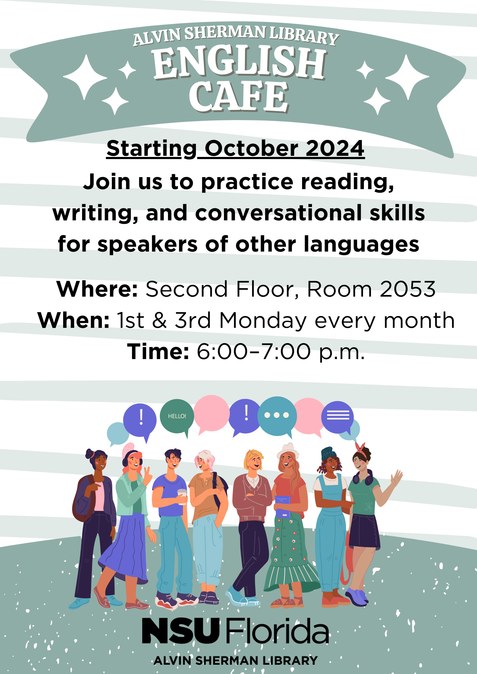
A free, recurring program I created for adult speakers of other languages to practice reading, writing, and conversation in English in a relaxed, welcoming setting. The program met on the first and third Monday of each month at the Alvin Sherman Library, and I created new materials for every session.
To strengthen the curriculum, I worked with Broward County Library staff on its structure and on recommended resources, a natural fit with my TEFL training.
Program flyer. Tap to view full size.
Program design
Adult learners
Language learning
Curriculum development
Online workshopsLiaison instruction
Online Library Workshops for the College of Computing and Engineering
Two live online workshops I delivered as library liaison to NSU’s College of Computing and Engineering (now the College of Computing, AI, and Cybersecurity). Introduction to the Library oriented students to the library’s resources and services, and Accessing Dissertations showed them how to find and access dissertations for their own research.
Online instruction
Liaison partnership
Research skills
Learner guides
Multi-page reference guides that learners return to on their own.
Guide and workshopMulti-page guide, live demos
Basic Look at Video Editing
I first built this guide when a faculty member asked for help supporting a video project in her class. It grew into a hands-on workshop I deliver to her students each semester, where I walk through the guide and demonstrate iMovie and Adobe Premiere Rush. I have also given video editing demonstrations for a COMP 1500 class and during a THEA 1500 tour of the Digital Media Lab and Makerspace.
The guide itself is a beginner's guide to iMovie and Adobe Premiere Rush, organized by task: creating and exporting projects, working with audio, and using editing tools. It also covers copyright basics, citing media, and where to find free-to-use images, video, and music.
The resource hub I maintain as liaison to NSU's College of Computing, AI, and Cybersecurity. It brings together databases, statistical software access, LinkedIn Learning, journals, ebooks, and library services for students and faculty.
Print pieces that help people discover library resources and keep learning after a session ends.
Outreach campaignFeatured project, 2026
Library of Things: Collectible Bookmark Campaign
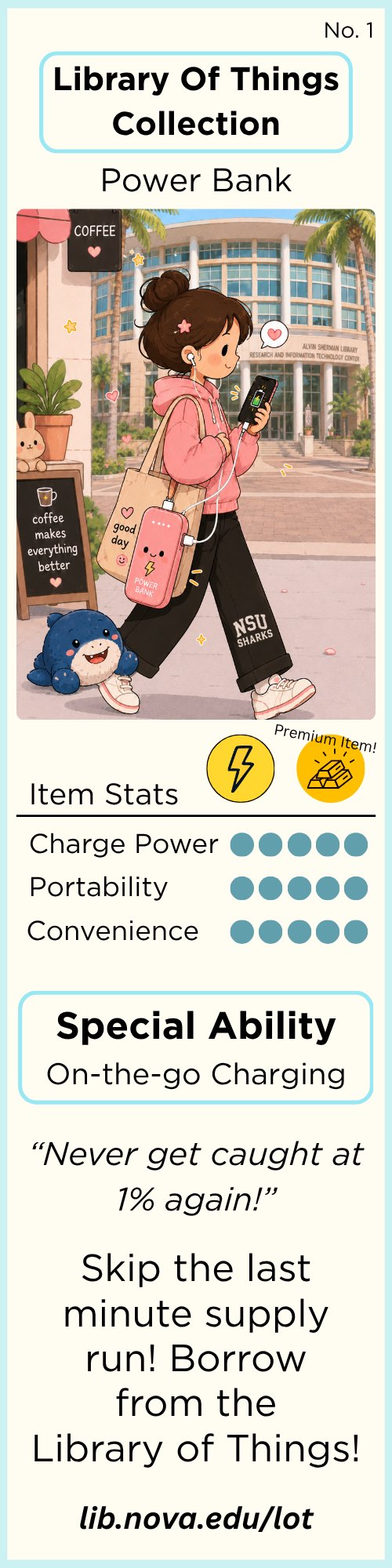
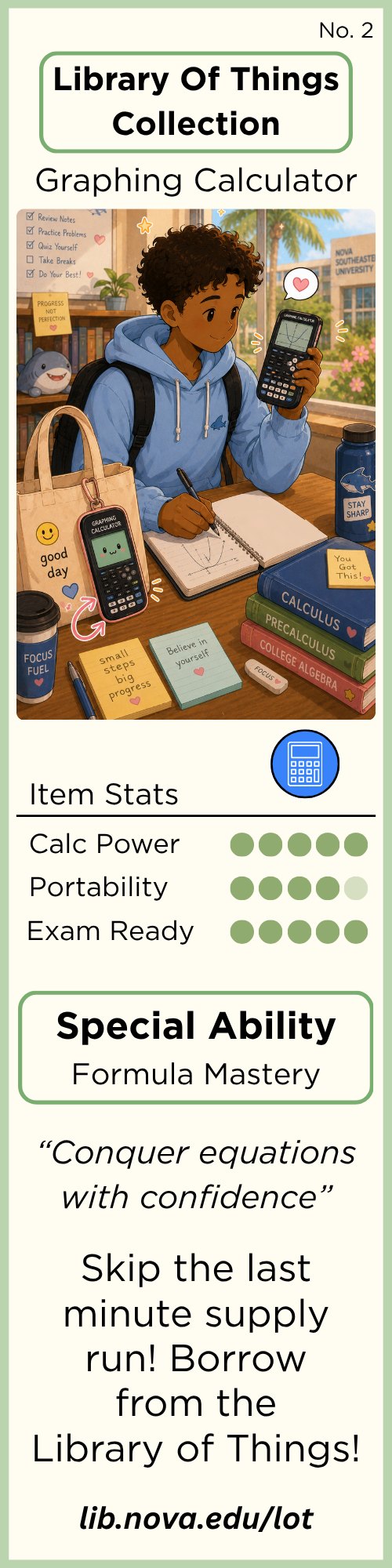
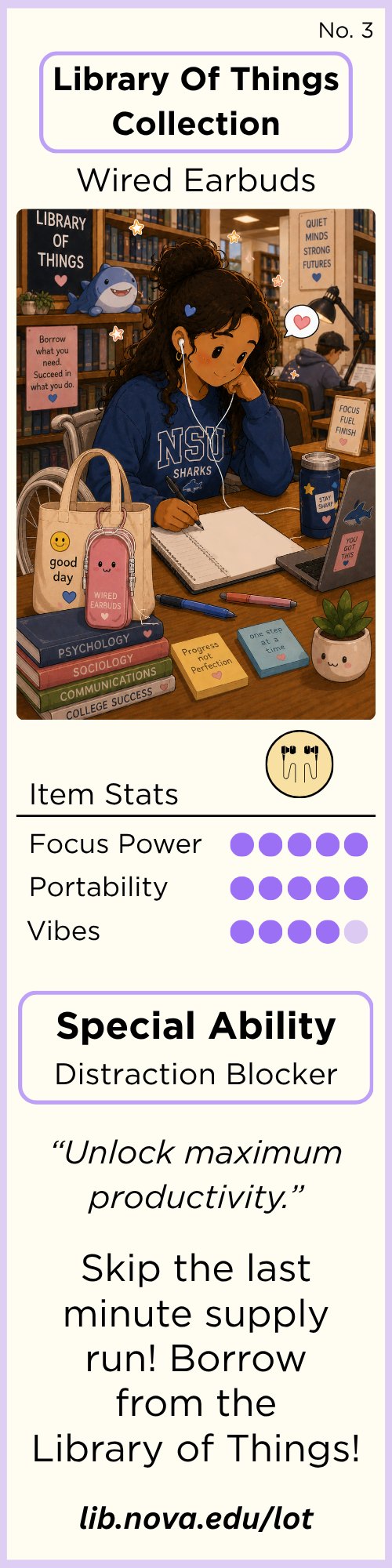
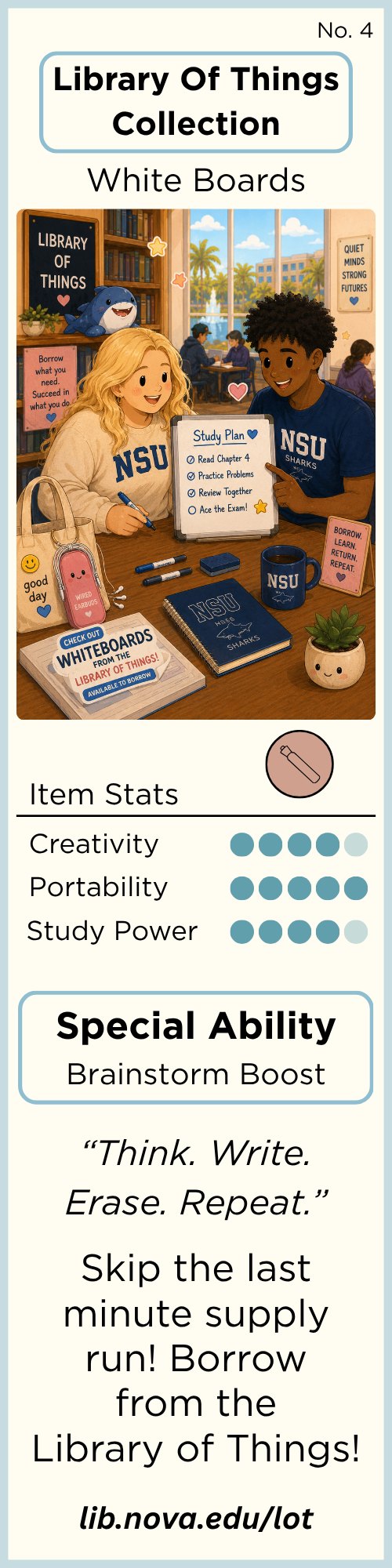
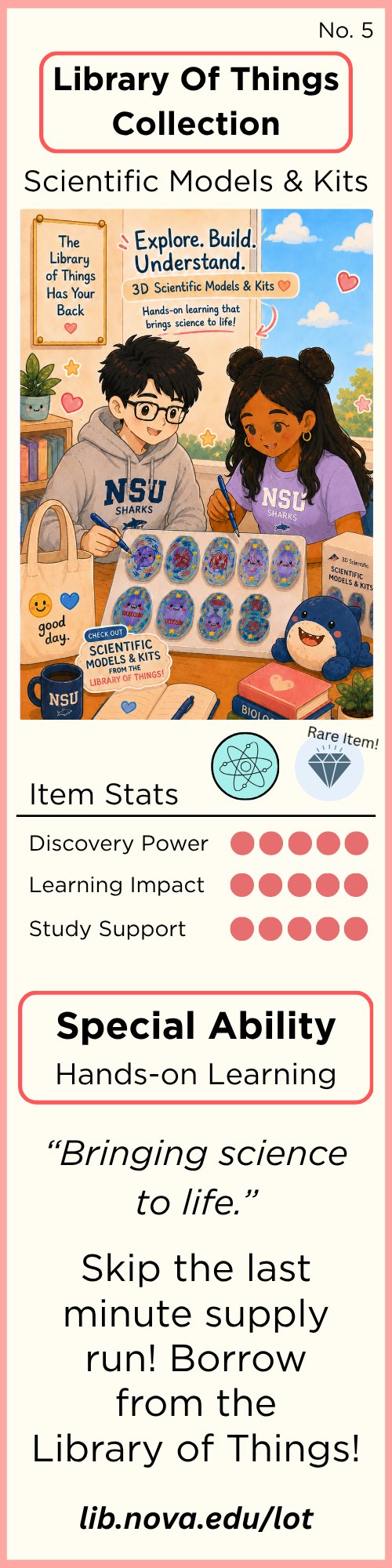
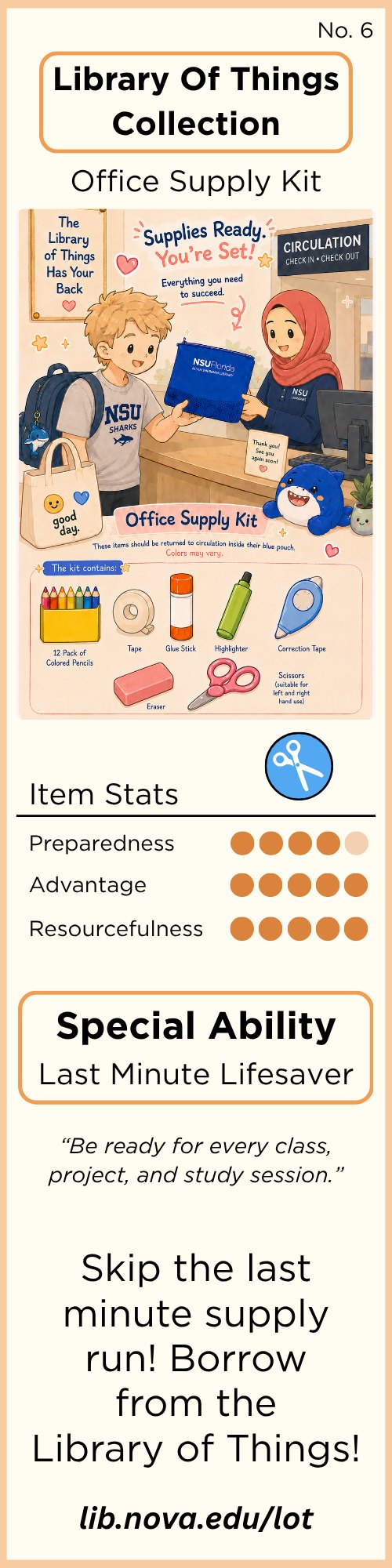
Most people think of an academic library as books, databases, and study space. To show students and visitors everything else they can borrow, I created a series of six collectible bookmarks for the Alvin Sherman Library’s Library of Things, each featuring a different item, from power banks and graphing calculators to science models and an office supply kit.
The concept
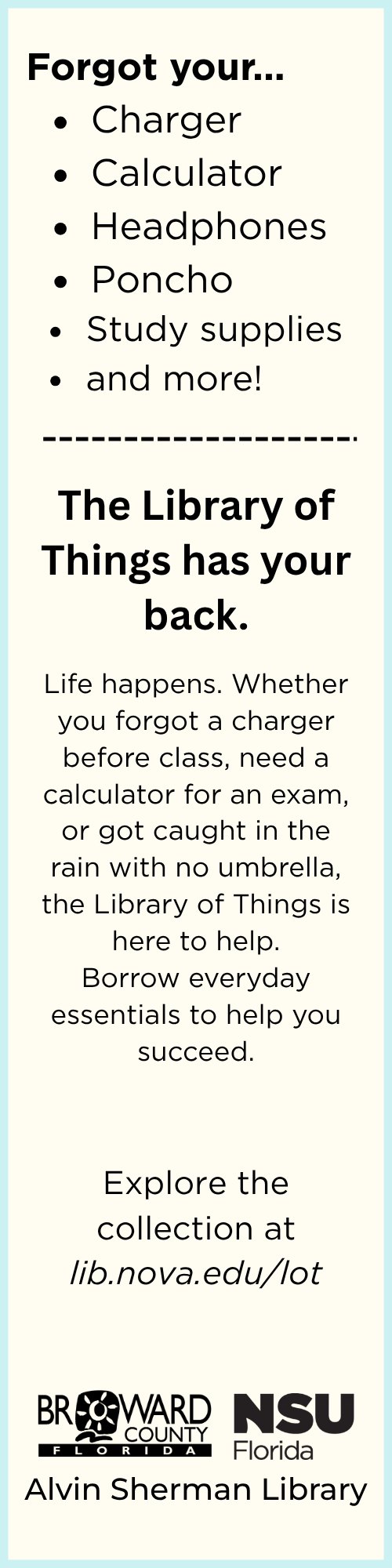
Instead of a standard informational handout, I borrowed ideas from trading cards and sticker collections. Each bookmark is numbered, No. 1 through 6, and gives its item playful “stats” and a “special ability,” so the set feels like something worth keeping and completing. The back of every bookmark carries the practical message: what the Library of Things offers and where to explore the collection.
Design process
I set the creative direction for a soft, storybook-style look: pastel colors, rounded characters, simple backgrounds, NSU branding, and a recurring shark plushie mascot. The original Power Bank artwork became the reference for the whole series. When later concepts drifted toward a more realistic or anime-like style, I brought them back to that original direction, choosing consistency over complexity and recognizability over realism.
The illustrations were created with generative AI image tools under my direction. I wrote and refined the prompts, compared versions, and rejected anything that broke the established style, then laid out each bookmark with its item stats, special ability, and call to action. Treating AI as a design tool, rather than letting it set the look, is what kept six separate images reading as one collection.
The full collection. Tap any bookmark to view it full size.
Getting students to explore
Rather than stacking all six designs at one desk, I split them across three service points, two per desk, so collecting the full set means visiting different parts of the library and meeting the staff there.
I also planned the physical display at the Academic Reference Services suite entrance and coordinated with staff to keep the bookmarks organized and available.
Shared back, color-matched to each front
Creative direction
AI-assisted design
Prompt writing
Design iteration
Gamification
User-centered design
Visual branding
Distribution planning
Print job aidTwo-sided bookmark
Online Resources Bookmark
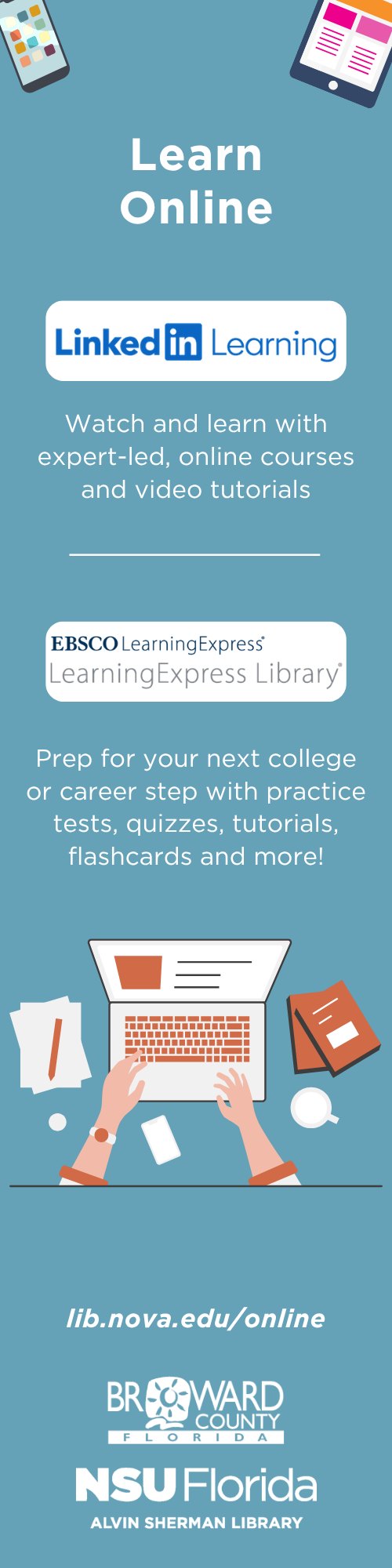
A two-sided bookmark that introduces the library’s digital collections. The Read Online side covers cloudLibrary, Comics Plus, and Flipster, with app store badges so readers can download the apps right away. The Learn Online side covers LinkedIn Learning and LearningExpress Library and points to lib.nova.edu/online.
I designed it as a take-away for library instruction sessions and the reference desks, giving each resource a one-line, plain-language description so learners know what it is for at a glance.
Read OnlineLearn Online
Job aid design
Plain-language writing
Visual hierarchy
Print design
Certifications
Credentials in security, research analytics, language teaching, and STEM education.
CertificationEarned October 2026
TestOut Security Pro
A CompTIA TestOut certification earned through a 100% performance-based exam. Instead of multiple-choice questions, the exam requires completing hands-on tasks in simulated environments, showing practical skill in essential elements of computer and network security.
It covers access control and identity management, cryptography, policies and security awareness, physical security, perimeter, network, host, application, and data defenses, and security assessments and audits.
Elsevier’s certification program for SciVal, its research analytics platform for exploring research activity, benchmarking performance, and finding collaboration opportunities using scholarly metrics.
This certification is the foundation for Learning SciVal, the Canvas course I am adapting from Elsevier’s training to teach NSU faculty how to use SciVal with their own research data.
An accredited 120-hour Teaching English as a Foreign Language course from Let’s TEFL, accredited by the World TEFL Accrediting Commission (WTEFLAC). It covers the full range of skills needed for the ESL classroom, from grammar and the four language skills to lesson planning and assessment.
The course trained me to teach young learners, teenagers, and adults, adapt to different learning styles, check for understanding, and keep learners motivated, skills that carry over to designing instruction for diverse learners.
A six-hour educator professional development certification offered through the NASA Educator Professional Development Collaborative (EPDC) and Texas State University’s LBJ Institute for STEM Education and Research.
The training certifies educators to use NASA’s lunar and meteorite sample disks in teaching and outreach.